
KWD Industrial Couplings
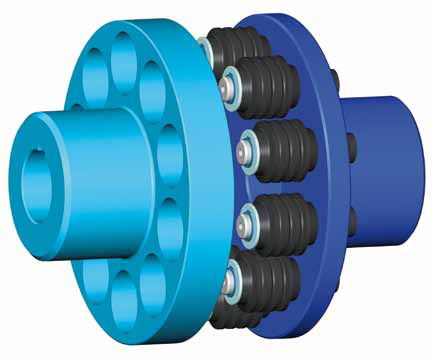
Flexible Pin Type Couplings BOKU-N
Flexible pin type couplings are positive-locking, torsionally elastic flexible shaft couplings with rubbery-elastic transmission elements. They are failsafe and pluggable. Buffer material and buffer geometry ensure an optimal balance between resilience and restoring action as well as good damping behaviour. The couplings exhibit progressive spring characteristics; buffers and bolts are interchangeable with those of earlier models. The operating temperature range is -40 °C (-25 °C for grey cast iron) to +100 °C depending on the buffer material (+120 °C possible for a short time).
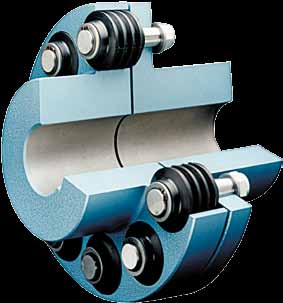
Technical characteristics
• Torque range 4 – 40,000 Nm (21 sizes)
• Assignment of driving and driven side is arbitrary; due to assembly the pin coupling has a small circumferential backlash
• Buffers made of NR-SBR (75 Shore A); coupling components in steel
• Material selection for pins and buffers depends on the rotational speed: grey cast iron for low speeds, steel solutions for high speeds; welded designs available
• Buffers and bolts are interchangeable, simplifying maintenance
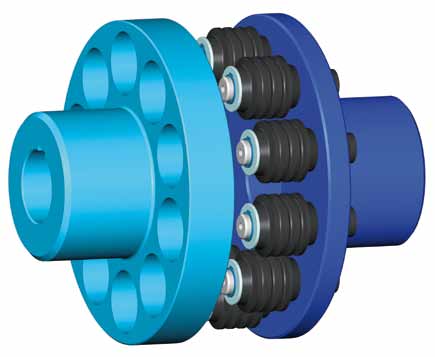
Designs
• Designs A / B — standard designs (A horizontal, B vertical installation)
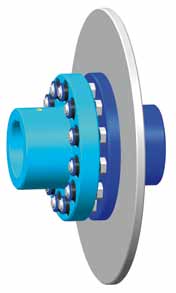
• Design P — with brake drum
• Design S1 — with brake disc
• Design S2 — with radially removable brake disc
• Design H — with spacer
• Special designs: axial backlash limitation, safety element, explosive environments (II 2G IIB T5 / II 2D 90 °C), elastic pin couplings per KWN 22009, electrically insulating, backlash-free due to prestress, switchable at standstill, hydraulically removable pins, low-temperature version and more
Coupling selection
Couplings are selected according to DIN 740 part 2, ensuring the permissible stress is not exceeded in any operating condition: nominal torque TKN ≥ TN·st·sa and maximum torque TKmax ≥ Tmax·st·sa. The temperature factor st accounts for the reduction of buffer resilience at higher ambient temperatures; the start-up factor sa accounts for additional stress caused by the frequency of start-up and braking torque impacts. Where vibration torques, torque impacts or high moments of inertia between driving and driven side occur, a more precise calculation method should be used.
Typical applications
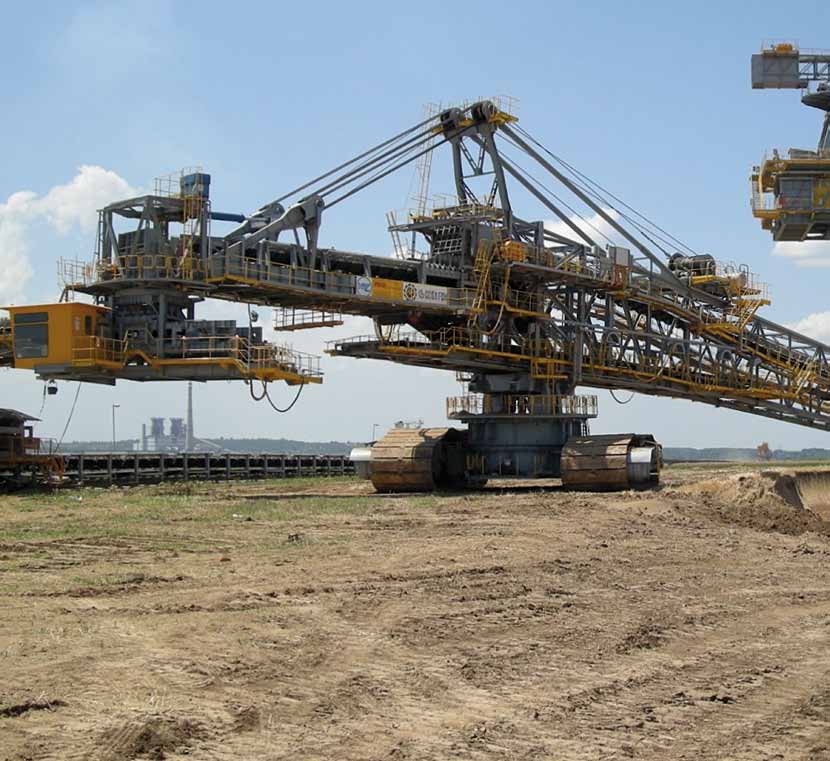
Mineral handling, conveying machinery, lifting and excavating equipment and general mechanical drives.